
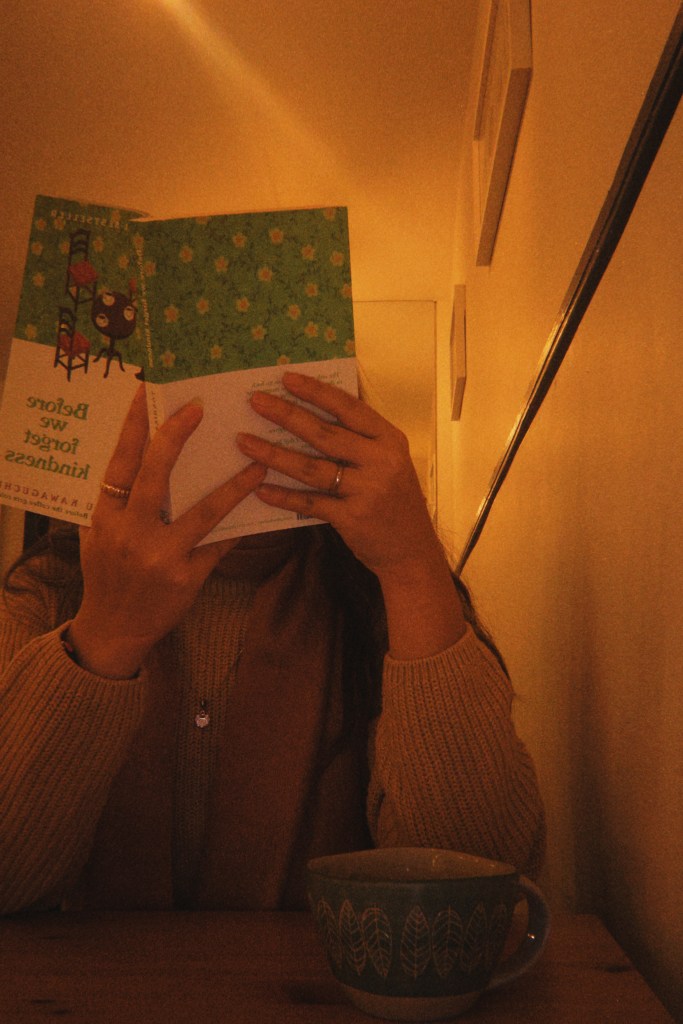
I was and still am a big fan of the popular novel Before the Coffee Gets Cold by Toshikazu Kawaguchi. My mum first placed the book in my sceptical hands three years ago with promises that it’d certainly make me cry. And it surely didn’t disappoint. It came as a recent surprise to find that it is the first of a pentalogy, and that I just so happened to land my hands on Kawaguchi’s fifth and most recent book of the series, Before We Forget Kindness. For me, the lingering resonance of a good book often outlasts the details of its plot, and I openly admit my judgment is coloured by a story’s ability to reduce me to tears. When I first saw the newest addition while browsing a bookstore, I could barely remember the individual characters of Before the Coffee Gets Cold and their stories, but memories of me breaking down bawling after reading it came flooding back. Despite already busting this month’s budget, I knew I just had to get hold of this one as well.
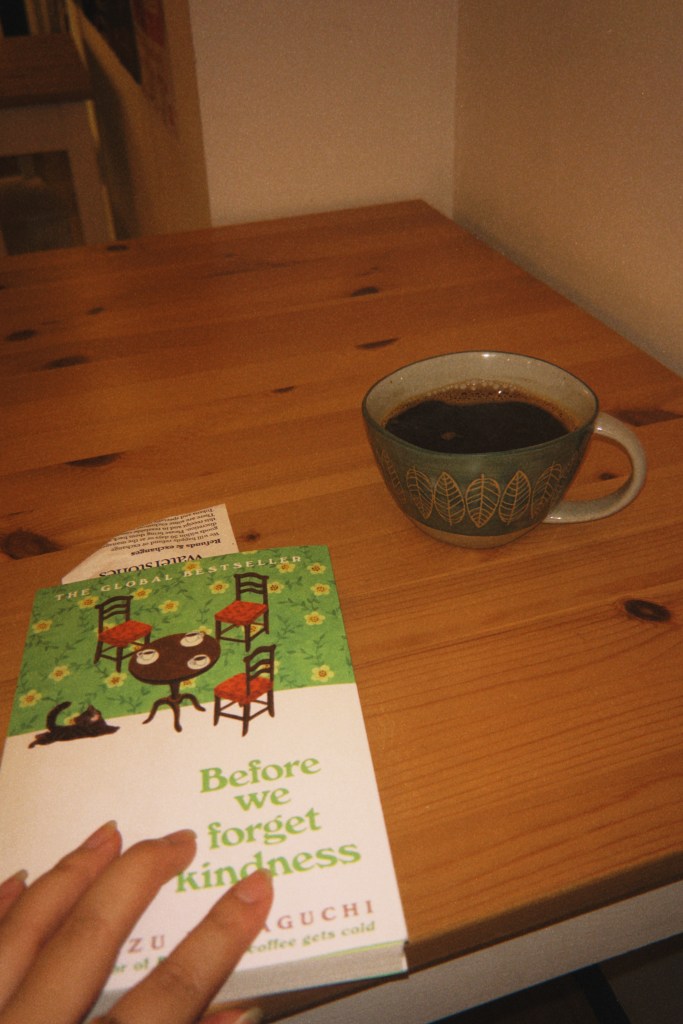
So I picked today: a slow, leisurely Saturday to park myself at a little Taiwanese cafe, a five-minute walk away from my hostel. With the arrival of winter meant the slow fading of autumn’s vibrancy, and the sky had darkened considerably despite it just being slightly over 4pm. The little bells hung on the door jingled softly as I pushed the cafe door open, and I shared an awkward eye contact followed by a little bow of greeting with the Taiwanese lady boss, who seemed surprised to receive a customer. After a quick order, I took my time settling down, taking off my coat and admiring the Studio Ghibli-inspired decor before taking a seat. I was the only customer in the adorably decorated cafe with soft piano music playing in the background, and as soon as the lady boss set my steaming cup of Americano down before me, I eagerly opened the book Before We Forget Kindness.
The book followed a similar structure to Before the Coffee Gets Cold and presumably the other three books as well: four short stories featuring four different people who wish to travel back or forward in time. While the first story began more gently, it still tugged at the same strings. As with Kawaguchi’s earlier book, I found myself slowly pulled deeper into the lives of complete strangers. Meanwhile, my own coffee, untouched in the midst of my absorption, cooled quietly beside me. And I know, I know, it’s cliche as hell! But it was rather amusing to see myself mirroring the theme of the book almost too neatly.
As I finally flipped over the last page of the book, I did so with a quiet reluctance. I took a look into my cup and realised I had just a little left of the black substance. Placing the book down, I gulped down the last bit and realised it had already gone completely cold. My tears had long started pooling in my eyes and I just knew they were threatening to escalate into heaving sobs. I made a futile attempt to stop them by rubbing my hands over my eyes, but the tears continued to flow and blur my vision. I had no choice but to haul my coat over myself, mutter a quick thanks to the lady boss and thrust myself back to the coldness of the outside world before I could embarrass myself further.
On my way home, I was pondering what made this book and its predecessor so poignant. And as I stood shivering in the chilly night waiting for the traffic light to turn green, I came to the conclusion that it’s because his characters move through choices that feel painfully ordinary, and therefore relatable: moments any of us could land in unexpectedly. The chair in the cafe may promise them a second passage through time, but the real tension sits in everything they cannot undo. What struck me most was not the theme of time-travel, which might be familiar to readers of the first book, but the emotional clarity with which Kawaguchi manages to enunciate the exasperating imperfections of how we love.
The father-and-daughter pair in this book reminded me a little of my own father and myself, and by extension, the rest of my familial relationships as well. It is a familiar kind of conflict, born out of worry, pride and care that tangles itself in a messy way that happens to the closest of kin.
Before the Coffee Gets Cold and Before We Forget Kindness are not merely a collection of fictional time-travel tales. And it also isn’t so much about the coffee getting cold, isn’t it? But they are about what we do before things get cold. Before relationships cool and break apart from pride and spite, before we lose someone and regret what should have been said.
And obviously, in reality, the Funiculi Funicula cafe in a back alley of Tokyo doesn’t exist. We don’t get an opportunity to wait for the ghost in the white dress to get up from her seat and decide which point in time to go back to, so that we can rewrite the past and fix our faults.
So before your coffee gets cold—whatever that “coffee” may be in your life—will it be too cliche to say ‘live every day as if it’s your last’? SAY the thing while it’s still honest, APOLOGISE while the door is still open, and choose to LISTEN. We will never get to sit in a time-travelling chair, but you reading this now means you still have the gift of today. And maybe that is the whole point Kawaguchi was trying to make: not so much the ability to return to the past, but the appreciation of the present;
While it is still warm in our hands.
 pingguoeatspies
Leave a comment